
Part VI: Advanced: AI Agents and Human-AI Systems | Chapter 25
Building an AI-Powered Organisation
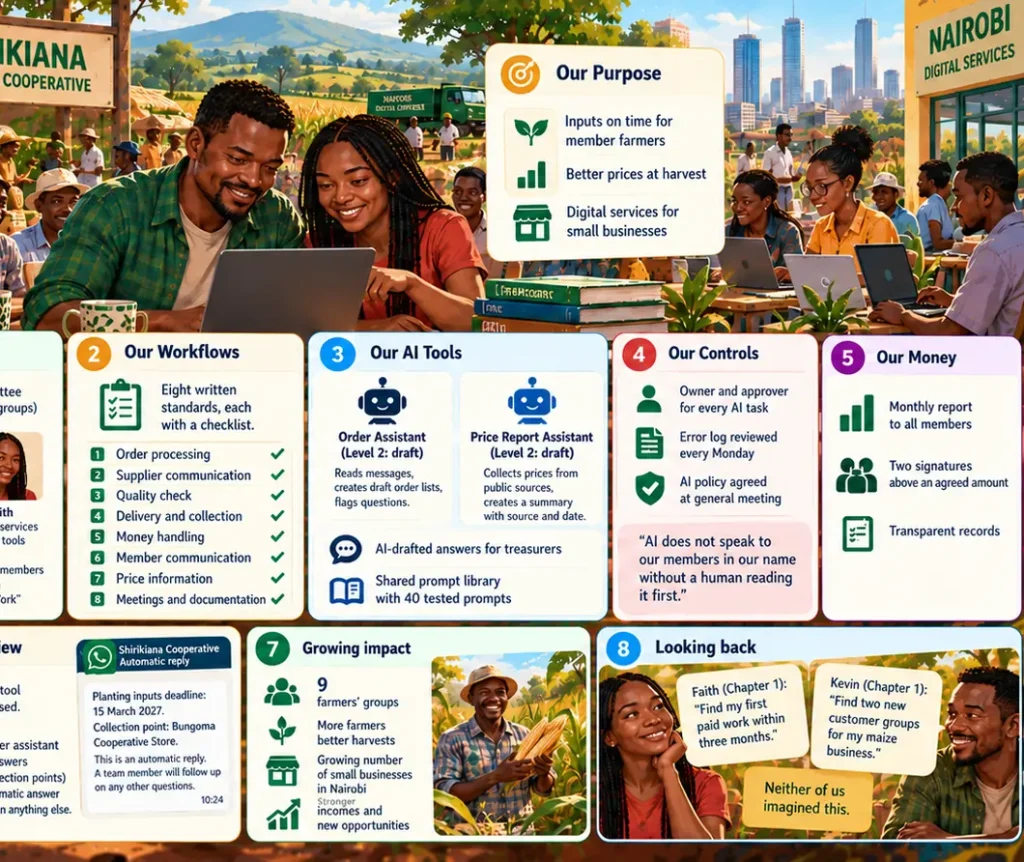
The Goal
By the end of this chapter you will be able to see an organisation as one complete system: its purpose, people, workflows, AI tools, knowledge and controls. You will write a one-page AI policy for your group, know how to keep costs and value in view, and have a step-by-step path to grow from first experiments to a well-run organisation.
Understand: the whole system
In this book you have built many pieces: prompts, workflows, a business model, roles, a knowledge system, agents. An AI-powered organisation is not a collection of tools. It is these pieces working together.
| Layer | The question | What you built in this book |
|---|---|---|
| Purpose | Why do we exist, and for whom? | Shared goal (Ch. 20), business model (Ch. 15) |
| People and roles | Who does what, who decides? | Roles and governance (Ch. 20) |
| Workflows | How does work flow, step by step? | Workflows (Ch. 8), standards (Ch. 21) |
| AI tools and agents | Where does AI help, at which level? | Prompts (Ch. 4), agents (Ch. 22–23), task modes (Ch. 24) |
| Knowledge and data | What do we know, where is it, who can access it? | Knowledge system (Ch. 21) |
| Controls | How do we keep quality, safety and trust? | Checklists, approvals, owners, error log (Ch. 21, 24) |
| Money | Where does it come from and go, who sees it? | Unit economics (Ch. 15), transparent records (Ch. 20) |
When something goes wrong, the cause is often between the layers: an agent without an owner, a workflow nobody wrote down, data nobody protects. Look at the whole system regularly.
Continue with Missing Linkk Learn
The rest of this chapter is for members. Early access is free until 31 March 2027: every chapter, every prompt, and your own results saved on your phone.