
Part VII: Ready for Real Life | Chapter 26
Understand Money
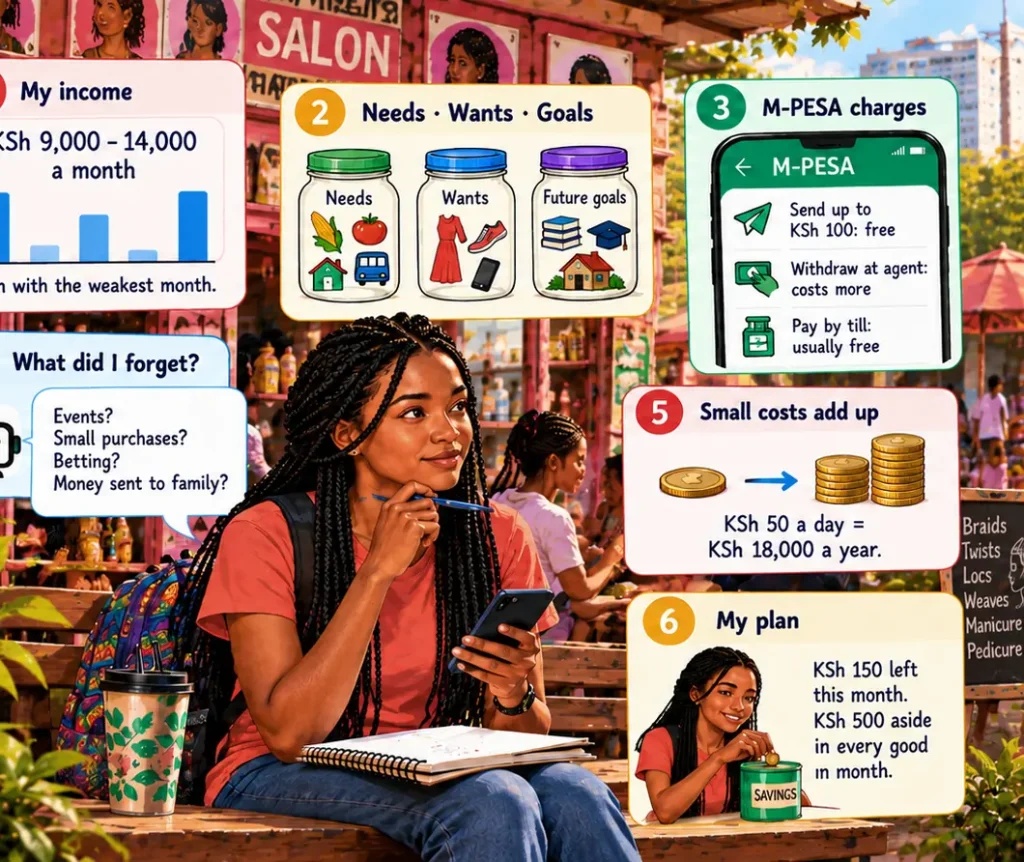
The Goal
By the end of this chapter you will have a simple monthly budget that works even when your income changes from month to month. You will know where small costs quietly eat your money, what M-PESA charges really cost you, and how to use AI to understand your spending without sharing a single private detail.
A word before Part VII
Parts I to VI were about AI. Part VII is about life: money, documents, work, taxes and your plans — and how AI helps you handle them. You can read this part at any time. If you start here, read Chapters 3 and 4 first.
For this part we go back in time. We meet Faith in the year after she left school — but this time she already knows everything you have learned in this book. Kevin stays where we left him.
Understand: income is not the same as available money
Imagine you earn KSh 15,000 a month. It feels like KSh 15,000 to spend. But part of it is already taken before it arrives: food, transport, rent or a contribution at home, airtime, family responsibilities.
What remains is not automatically free for shopping or going out. You also need something for the broken phone, the course that could get you better work, the month when less comes in.
A budget is simply a plan for your money before you spend it. A notebook, a spreadsheet or a list on your phone is enough.
Understand: needs, wants and future goals
Sort your spending into three groups:
- Needs — food, housing, transport to work, basic airtime and data, necessary medical costs.
- Wants — things that make life enjoyable but can be reduced or postponed: extra entertainment, eating out, impulse purchases.
- Future goals — savings, education, tools for work, paying off debt.
The line is not always obvious. A smartphone is a need if you use it to find or do work. The newest model is a want. The point is not to judge your spending. It is to decide with your eyes open.
Understand: when your income changes every month
Most young people do not start with a fixed salary. They start with casual work, a stall, small jobs, a few clients. One month brings KSh 14,000, the next KSh 8,000.
The rule for irregular income is simple: plan with your weakest month, not your best one. Cover your needs from what you can count on. When a good month comes, the extra goes first into savings for the weak months — not into new spending.
Understand: small costs become big costs
M-PESA makes sending and receiving money easy. But the charges depend on the type of transaction and the amount, and the differences are bigger than most people think:
- Sending small amounts is cheap. Sending up to KSh 100 is currently free.
- Withdrawing cash at an agent usually costs more than sending the same amount.
- Paying a business through Lipa na M-PESA Buy Goods (a till number) usually costs the customer nothing.
So the expensive habit is often not the number of transactions. It is withdrawing cash to pay someone who would have accepted M-PESA anyway. Two unnecessary withdrawals a week at around KSh 30 each cost about KSh 240 a month, or nearly KSh 3,000 a year.
Other small costs work the same way: the daily snack, the extra bundle, the delivery charge. None of them is a mistake on its own. Repeated every day, they become one of your biggest expenses.
Understand: betting is not income
Sports betting is everywhere in Kenya, and many young people bet small amounts every day. Fifty shillings a day sounds like nothing. It is KSh 1,500 a month and KSh 18,000 a year.
Betting companies are built to win over time. That is their business model. If you bet, put it in your budget under wants, write down every stake and every win honestly, and look at the total after three months. Most people are surprised by the number.
Understand: the 50/30/20 rule — a guide, not a law
A popular method splits income into three parts:
| Category | Share | From KSh 15,000 |
|---|---|---|
| Needs | 50% | KSh 7,500 |
| Wants | 30% | KSh 4,500 |
| Savings and goals | 20% | KSh 3,000 |
If your needs already take more than half your income, these numbers are not realistic. Then start smaller: KSh 100 or 200 whenever money comes in. A budget should reflect your real life, not make you feel you have failed.
See It in Action
Faith earns money from two sources: weekends at her aunt’s salon and small jobs during the week. Some months she has KSh 14,000, some months KSh 9,000. Near the end of every month, almost nothing is left, and she doesn’t know why.
She does not upload her M-PESA statement. She goes through it herself, adds up the totals for each category and types only those:
My income last month was KSh 12,000. I spent: household contribution and food 5,000, transport 2,000, airtime and data 1,000, personal purchases 1,500, M-PESA charges 300, other 1,200. My income changes between 9,000 and 14,000 a month. Add it up, tell me what should be left, and ask me what I might have forgotten.
The assistant adds up KSh 11,000 and says KSh 1,000 should be left. Then it asks: “Did you include contributions to events, small purchases under KSh 200, betting, or money sent to friends and family?”
Faith checks her statement again. Two small purchases she forgot: KSh 350. A contribution for a cousin’s wedding: KSh 500. Now the numbers match her wallet: KSh 150 left.
The assistant makes one more point: her plan only works in a good month. In a KSh 9,000 month she would be KSh 2,850 short. Faith decides on two changes: she will pay by till wherever a shop accepts M-PESA instead of withdrawing cash, and she will put KSh 500 aside in every good month for the weak ones.
She has not become rich. She has something better: she knows where her money goes.
Try It Yourself
- Write down how much came in during each of the last three months. Note the lowest.
- Go through one month of your M-PESA statement and add up the totals per category. Do this yourself, on your phone or on paper.
- Check how much you paid in charges, and which of those were withdrawals.
- Decide on one amount, however small, that you will set aside when money comes in.
Copy & Paste Prompt
Fill in the parts in [brackets] with totals only — never names, numbers or transaction codes.
Help me make a realistic monthly budget in Kenyan shillings.

My income: in a weak month about KSh [amount], in a good month about KSh [amount].
My monthly spending:
- Housing / household contribution: [amount]
- Food: [amount]
- Transport: [amount]
- Airtime and data: [amount]
- Personal purchases and entertainment: [amount]
- M-PESA and bank charges: [amount]
- Other: [amount]
My savings goal: [goal and amount].

Please:
1. Add up my spending and show what is left in a weak and in a good month. Show every step.
2. Ask me about costs I might have forgotten.
3. Show me the yearly cost of my small repeated expenses.
4. Suggest three realistic changes. Don't judge my choices.
5. Suggest a savings amount that works in my weak month.
Do not invent current M-PESA charges or bank fees. Tell me what I need to check myself.
Improve the Result
- “My transport can’t be reduced — I travel to work every day. Find savings elsewhere.”
- “I support my family and can’t change that amount. Plan around it.”
- “Show me what happens if I save KSh 200 per week instead of KSh 1,000 per month.”
- “Turn my budget into a table I can copy into Google Sheets.”
Check Your Work
- Do the totals add up? Did I check the arithmetic myself?
- Did I include irregular costs: events, repairs, school fees, medical costs?
- Does the plan work in my weakest month?
- Did I check real charges against Safaricom’s current tariff?
- Did I share only totals — no names, numbers or codes?
Apply It
Track your money for one month in broad categories. Once a week, check whether the plan still matches reality. At the end of the month, compare the plan with what really happened and choose one change for next month.
Faith does the same. In her first month she discovers that her biggest surprise was not one large expense, but fifteen small ones.
Key Takeaways
- Your income, your fixed costs and your available money are three different numbers.
- With irregular income, plan with your weakest month.
- Small repeated costs — charges, snacks, bets — become big costs over a year.
- AI can add up, ask what you forgot and show you patterns. You check the numbers.
- Work with totals, never with your full statement, PINs or codes.